
Governance
Overview of Policies and Guidelines: Following the Acer Group’s Governance Framework
Acer Gadget follows the Acer Group’s governance policies and international guidelines to ensure transparent and compliant operations while continuously promoting the coordinated development of the economic, environmental, and social dimensions. Guided by international frameworks and integrated with the Group’s policies, we are establishing a corporate governance system that combines competitiveness with social value.
Guiding Frameworks
United Nations Guiding Principles on Business and Human Rights (UNGPs)
Corporate Sustainability Best Practice Principles for TWSE/TPEx Listed Companies
Ethical Corporate Management Best Practice Principles for TWSE/TPEx Listed Companies
Corporate Governance Best Practice Principles for TWSE/TPEx Listed Companies
OECD Principles of Corporate Governance
Acer Group Policies Followed by Acer Gadget
- Acer Sustainable Development Policy
Based on the Corporate Social Responsibility Best Practice Principles, promoting coordinated development across the economic, environmental, and social dimensions. - Acer Corporate Governance Principles
Following Acer’s governance framework to establish effective operating mechanisms for the Board of Directors and functional committees. - Acer Ethical Corporate Management and Anti-Corruption Policy
Based on Acer’s Ethical Corporate Management Principles, implementing measures related to anti-corruption, antitrust, and codes of ethical conduct. - Acer Responsible Supply-Chain Management (ARSM) Policy
Ensuring transparency and compliance throughout the supply chain while emphasizing a commitment to ethical business conduct. - Acer Risk Management Policy
Integrating Acer’s risk management framework to implement comprehensive risk management across both financial and non-financial dimensions. - Acer Human Rights Policy and Data Privacy Protection Policy
Based on ISO 27001 to safeguard the rights and interests of employees and customers and protect information security. - Acer Environmental, Health and Safety Policy
Strengthening practices related to environmental protection, safety, and health to advance sustainable business operations. - Acer Group Personal Data Protection Management Policy
Establishing a comprehensive personal data protection mechanism in accordance with ISO 27701 requirements to reduce information security risks. - Acer Group Artificial Intelligence Policy Statement
Ensuring that the development and application of artificial intelligence comply with ethical standards and are aligned with privacy protection principles. - Acer Group Intellectual Property Management Policy
Establishing an intellectual property management system to protect the Company’s innovations and enhance its competitiveness.
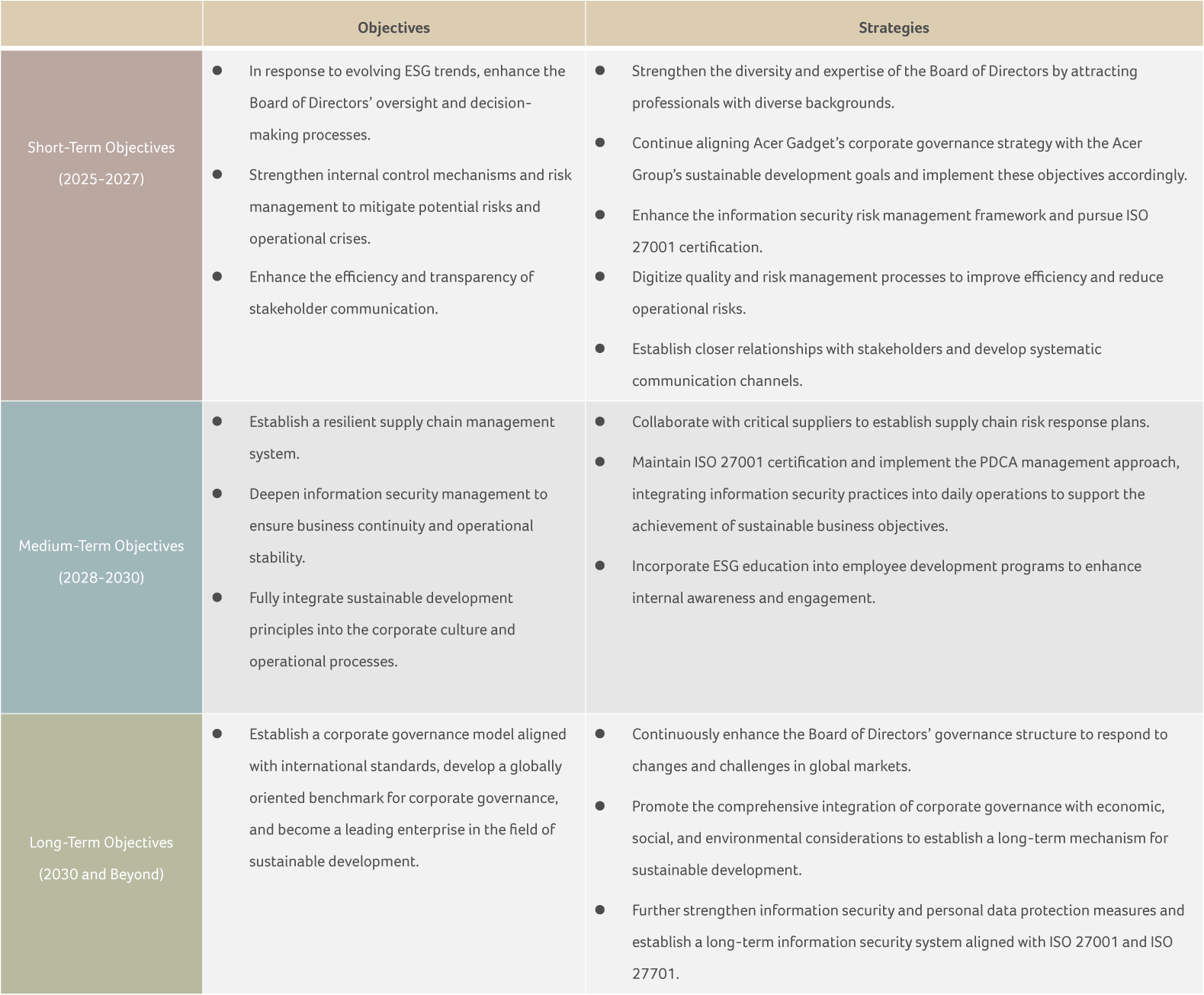
To continuously strengthen its corporate governance practices, Acer Gadget integrates the Acer Group’s governance framework with international trends in sustainable development to establish short-, medium-, and long-term objectives. Through systematic strategies, the Company advances its governance initiatives and ensures its commitment to sustainable business operations across the economic, environmental, and social dimensions.
Management Mechanisms
- In accordance with governance practices and guidelines, the results of the Board of Directors’ performance self-evaluation are compiled regularly and used as a reference for reviewing overall governance performance and determining future priorities.
- Governance priorities are reviewed monthly at operational management meetings, where the senior management team builds consensus and monitors implementation progress.
- Acer Gadget continuously enhances its corporate governance information disclosure processes and strengthens communication and feedback mechanisms between the Board of Directors and internal functions to improve decision-making transparency and governance effectiveness.
Going forward, Acer Gadget will make ongoing adjustments to its governance priorities and implementation mechanisms in response to recommendations from the Board of Directors and evolving regulatory requirements.
Acer Gadget reviews the effectiveness of its governance operations annually through the Board of Directors and functional committees. Key strategic matters are also monitored and reviewed as appropriate to support the continuous enhancement of the Company’s overall governance framework. Acer Gadget conducts an annual internal self-assessment of its corporate governance practices and discloses the results in its annual report to promote transparency. In addition, Independent Directors hold regular annual meetings with Certified Public Accountants (CPAs) and the head of internal audit, enabling them to effectively fulfill their oversight and advisory responsibilities.
To ensure a clear governance structure and effective operations, Acer Gadget has established a comprehensive organizational framework comprising the Board of Directors, functional committees, and professional management team. The organizational structure is designed to support the Company’s corporate governance objectives, with clear functional specialization and defined responsibilities to ensure that each department contributes to synergies across the economic, environmental, and social dimensions.
Integrity Management
In accordance with the Corporate Governance Best Practice Principles for TWSE/TPEx Listed Companies, Acer Gadget has designated a group of senior executives to serve as the Company’s dedicated corporate governance function, responsible for promoting and implementing matters related to corporate governance. The dedicated corporate governance function covers key areas including the Company’s internal governance system, information disclosure, regulatory compliance, and risk management. In accordance with applicable laws and the Company’s internal regulations, relevant corporate governance information and performance are disclosed externally, while the operation of corporate governance is reported internally to the Board of Directors, thereby strengthening transparency in corporate governance information.
Main Responsibilities:
- Board Operations and Support: Assist in convening meetings of the Board of Directors and its committees to ensure transparent decision-making processes and compliance with Corporate Governance Principles.
- Information Disclosure and Legal Compliance: Ensure the timely and complete disclosure of corporate governance information in accordance with applicable laws and mechanisms for protecting shareholders’ rights and interests.
- Strengthening Internal Governance Systems: Continuously review and enhance internal governance mechanisms to ensure the effective implementation of compliance and risk management.
Ethical Business Conduct Principles, Policies, and Codes of Conduct
Based on its commitment to ethical business conduct, Acer Gadget is dedicated to ensuring that all business activities comply with ethical standards and applicable laws and regulations, while preventing the risks of fraud and misconduct. The Company has established the Ethical Corporate Management Principles, Procedures and Code of Conduct for Ethical Corporate Management, and Insider Trading Prevention Regulations. In formulating these policies and regulations, the Company also referenced the governance systems of the Acer Group to align its practices more closely with operational requirements and the Group’s overall governance framework.
Anti-Corruption Mechanisms
1. Acer Gadget adopts a zero-tolerance approach to all forms of corruption and bribery. Employees, business partners, and suppliers are strictly prohibited from offering or accepting improper benefits in any form, including cash, gifts, entertainment, kickbacks, or other benefits.
2. Integrity Commitment: All business partners and suppliers are required to sign integrity commitment statements to ensure that business relationships are conducted in accordance with the principles of ethical business conduct and to strengthen risk management.
3. The Company has established the Ethical Corporate Management Principles and Procedures and Code of Conduct for Ethical Corporate Management as internal guidelines for preventing misconduct. Acer Gadget has also established reporting channels to enable internal and external stakeholders to report suspected violations of laws or regulations.
Acer Gadget Dedicated Whistleblower Mailbox :WhistleblowerAGT@acergadget.com
Acer Group Whistleblower Mailbox (for reports handled at the Acer Group level) : Whistleblower.acer@acer.com
Ethical Business Conduct Performance
Acer Gadget is committed to maintaining strict confidentiality regarding all reported information and ensuring that whistleblowers do not suffer any form of retaliation or adverse treatment as a result of providing information. The Company also continues to strengthen its internal oversight mechanisms to uphold ethical business conduct and corporate governance. In 2025, as in 2024, no complaints were received and no cases of corruption occurred. Acer Gadget has never received any complaints or recorded any cases of corruption.
Anti-Competitive Behavior
Acer Gadget follows the Acer Group’s principles on antitrust and fair competition to ensure that all business activities comply with applicable legal requirements and to promote a free and fair competitive market. The Company strictly complies with relevant laws and regulations and prohibits improper conduct that could result in monopolization, price fixing, or restrictions on market competition, thereby supporting fair and stable market conditions. To further strengthen compliance awareness, the Company conducts regular annual antitrust training to enhance employees’ understanding of competition laws, ensure that all business activities comply with the Fair Trade Act, and reduce potential legal compliance risks.
Preventing Insider Trading
Acer Gadget has established the Insider Trading Prevention Regulations based on its operational needs. The regulations define access to and management authority over material information and prevent insiders from using non-public information to trade stocks or other securities, thereby safeguarding market fairness and investors’ rights and interests. The regulations were developed with reference to the Acer Group’s practices and are continuously reviewed and revised in response to changes in applicable regulations and business practices.
Statistics on Regulatory Violations in 2025: 0 cases; Acer Gadget did not experience any of the following regulatory violations in 2025.
1、Incidents of non-compliance concerning the health and safety impacts of products and services: 0 cases
2、Incidents of non-compliance concerning product and service information and labeling: 0 cases
3、Incidents of non-compliance concerning marketing communications: 0 cases
4、Receipt of significant fines due to breach of regulations regarding the provision or use of products or services: 0 cases
5、Penalties or relevant disputes related to competition: 0 cases
6、Monetary penalties or non-monetary sanctions imposed for unlawful conduct: 0 cases
7、Legal actions involving anti-competitive conduct, antitrust matters, or monopoly practices: 0 cases
Acer Gadget remains committed to legal compliance and compliance management, ensuring that all business operations comply with applicable domestic and international requirements. In accordance with the Company’s Procedures and Code of Conduct for Ethical Corporate Management, Acer Gadget strengthens its internal oversight and risk control mechanisms to promote transparency and stability in business operations. Acer Gadget has also established the Ethical Corporate Management Principles as an internal framework for promoting ethical governance and strengthening legal compliance, covering policies and measures for preventing unethical conduct.
Note: The Company’s legal compliance criteria are based on the Financial Supervisory Commission’s Reference Guidelines for Identifying Sustainable Operations Activities and take practical circumstances into consideration. The following criteria have been established for determining significant regulatory violations:
- A single incident is considered significant if it involves a material amount or has a material impact on the Company’s financial condition or reputation.
- As a general principle, a violation involving an amount exceeding NT$1 million is considered a significant regulatory violation.
- An incident is also considered significant if the competent authority orders the Company to suspend operations due to the nature of the violation, or if a license is revoked in Europe or a specific market as a result of the violation.
Communication Channels and Grievance Mechanisms
Upon receiving a report of any suspected violation of the Ethical Corporate Management Principles or applicable laws and regulations, the responsible unit will promptly investigate and verify the facts of the case. If a violation is substantiated, Acer Gadget will take appropriate action immediately, require the employee involved to cease the relevant conduct, and, where necessary, pursue appropriate legal action to protect the Company’s rights and reputation. Once the case has been confirmed, Acer Gadget will convene the relevant responsible units, including Human Resources, Legal, and Internal Audit, to review the applicable procedures and jointly determine appropriate corrective measures, thereby further strengthening the Company’s internal control system.
- When a whistleblower report or grievance is received, the Company’s designated unit (such as the Finance Department) will, depending on the nature of the case, convene relevant functions, including Legal, Human Resources, and Internal Audit, to form an investigation team and conduct the investigation confidentially and prudently.
- The designated unit also regularly reviews the status and progress of grievance cases at each subsidiary to monitor the implementation of the relevant mechanisms and strengthen cross-functional coordination.
- All cases received, whether submitted anonymously or with the reporter’s identity disclosed, must be properly documented, investigated, and responded to. Appropriate follow-up improvement measures will be implemented based on the investigation results to prevent similar incidents from recurring.
- The Company provides appropriate protection mechanisms for whistleblowers and personnel participating in investigations to prevent them from being subjected to improper retaliation or adverse treatment.
- The handling of grievance cases is periodically consolidated into reports submitted by the designated unit to the Audit Committee and the Board of Directors for review, thereby ensuring transparency in corporate governance.
To promote corporate governance transparency and safeguard stakeholders’ rights and interests, Acer Gadget has established formal whistleblower and grievance mechanisms. Stakeholders who become aware of unethical or improper conduct by Company personnel—including, but not limited to, suspected fraud, corruption, bribery, violations of laws and regulations, or breaches of the Company’s internal governance requirements—may report such matters through the channels below. The Company will conduct a preliminary review and clarify the relevant facts based on the information provided, take appropriate action depending on the circumstances of each case, strengthen internal control and risk management as appropriate, and protect the identity and rights and interests of whistleblowers.
Dedicated mailbox for reporting workplace sexual harassment and workplace bullying: AGT.HR@acergadget.com
Intended Users: Directors, managers, employees, customers, suppliers, investors, community members, and other stakeholders of Acer Gadget.
Risk Management
To institutionalize the management of risk and sustainability, the Company established the Risk Management and Sustainable Development Committee under the Board of Directors on November 7, 2025. More than half of the Committee’s members are independent directors, and the Committee is responsible for reviewing and overseeing relevant matters. Prior to the establishment of the Committee, the Company had established a Sustainable Development Working Group, chaired by the General Manager. In coordination with the Company’s governance mechanisms, the Working Group gradually integrated risk management-related responsibilities into its operations and, through cross-functional collaboration, incorporated the core processes of risk identification, assessment, response, and oversight into day-to-day operations.
The Risk Management and Sustainable Development Committee, within the scope of its authority, reviews and oversees key matters including strategic, operational, financial, and climate-related risks, greenhouse gas inventories, and sustainability information disclosure. The Committee meets at least once a year and regularly reports its operations and implementation progress to the Board of Directors. On August 5, 2025, the Company reported the progress of its greenhouse gas inventory and Sustainability Report preparation to the Board of Directors. The Company continues to advance risk management and sustainable development through the Board of Directors and related governance mechanisms.
Acer Gadget’s risk management policies and procedures cover the following core areas to ensure that risk management is effectively integrated into day-to-day operations and supports the achievement of corporate objectives:
(I) Risk Management Objectives
- Achieve operational objectives: Ensure the effective implementation of the Company’s short- and long-term strategic and operational directions.
- Improve management effectiveness: Integrate risk management into day-to-day operations and decision-making processes to improve management quality.
- Provide reliable information: Ensure the accuracy and transparency of internal operating data and external financial disclosures.
- Allocate resources effectively: Ensure that Company resources are allocated appropriately based on risk priorities.
(II) Risk Governance and Culture
- Top-down implementation: Foster a comprehensive enterprise risk management culture through the active participation and commitment of the Board of Directors, the Risk Management and Sustainable Development Committee, and senior management.
- Integration into day-to-day operations: Risk management is not an independent activity but must be deeply integrated into key organizational processes, including day-to-day operations and management activities.
- Continuous improvement through a cyclical process: The scope of risk management covers strategic, operational, financial, disaster, information security, climate change, and emerging risks. Through a continuous cycle of identification, analysis, assessment, response, monitoring, and review, together with organizational learning and experience sharing, the Company seeks to support sustainable operations and safeguard stakeholder rights and interests.
(III) Risk Management Organization and Responsibilities
The Company has established a clearly defined governance and accountability structure, with responsibilities assigned as follows:
- Board of Directors (highest decision-making body): Approves risk management policies, procedures, and frameworks; ensures alignment between operational strategies and risk policies; oversees the effective operation of the risk management mechanisms; and allocates adequate resources.
- Risk Management and Sustainable Development Committee (under the Board of Directors): Reviews the applicability of policies, approves risk appetite and risk prioritization, reviews and approves the implementation of the Risk Management Working Group, and reports to the Board of Directors regularly, at least once a year.
- Risk Management Working Group (comprising heads of business units/functions): Develops the risk management policy framework and risk appetite measurement criteria; conducts risk identification, analysis, assessment, and response activities; provides guidance and oversight to individual departments; and reports to the Committee regularly, at least once a year.
- Internal Audit (independent unit under the Board of Directors): Conducts independent reviews of the effectiveness of risk management activities in accordance with the annual audit plan and provides recommendations for improvement.
(IV) Risk Management Procedures
Risk management follows a structured six-step process:
1. Risk Identification: Combines bottom-up and top-down analysis and discussions to comprehensively identify potential risk events that may hinder the achievement of objectives.
2. Risk Analysis: Establishes quantitative and qualitative criteria based on the likelihood of occurrence and potential impact, and calculates risk values.
3. Risk Appetite: The Working Group develops risk tolerance levels for submission to the Committee for approval, providing the basis for determining the Company’s risk limits and risk levels.
4. Risk Assessment: Compares the results of risk analysis with the approved risk appetite, prioritizes risks for action, develops subsequent response plans, and maintains appropriate records.
5. Risk Response: Selects appropriate response measures, such as prevention, emergency response, crisis management, and business continuity plans, and establishes key risk indicators (KRIs) for ongoing monitoring.
6. Risk Monitoring and Review: Reviews the continued effectiveness of the processes and response measures described above and ensures their integration with the organization’s core processes.
Key risks are reported to the Board of Directors regularly to ensure that they are appropriately managed and controlled.
(V) Risk Reporting and Disclosure
- Internal Records and Review: All information sources, assessment results, response measures, and records generated throughout the risk management process shall be properly maintained and retained for reference through appropriate mechanisms. The Working Group shall regularly report its operations to the Committee.
- External Disclosure: To promote sound corporate governance and respond to stakeholder expectations, the Company shall publicly disclose and continuously update its risk management policies, procedures, organizational structure, and annual risk management operations and implementation status in its annual report, official website, or Sustainability Report.
Based on its operational characteristics, Acer Gadget categorizes risks into five major categories according to management priorities and develops specific strategies through cross-functional collaboration to strengthen organizational resilience. The Company regularly reviews internal and external risk response strategies to continuously enhance its risk management processes.
Detailed Risk Classification and Management Matrix
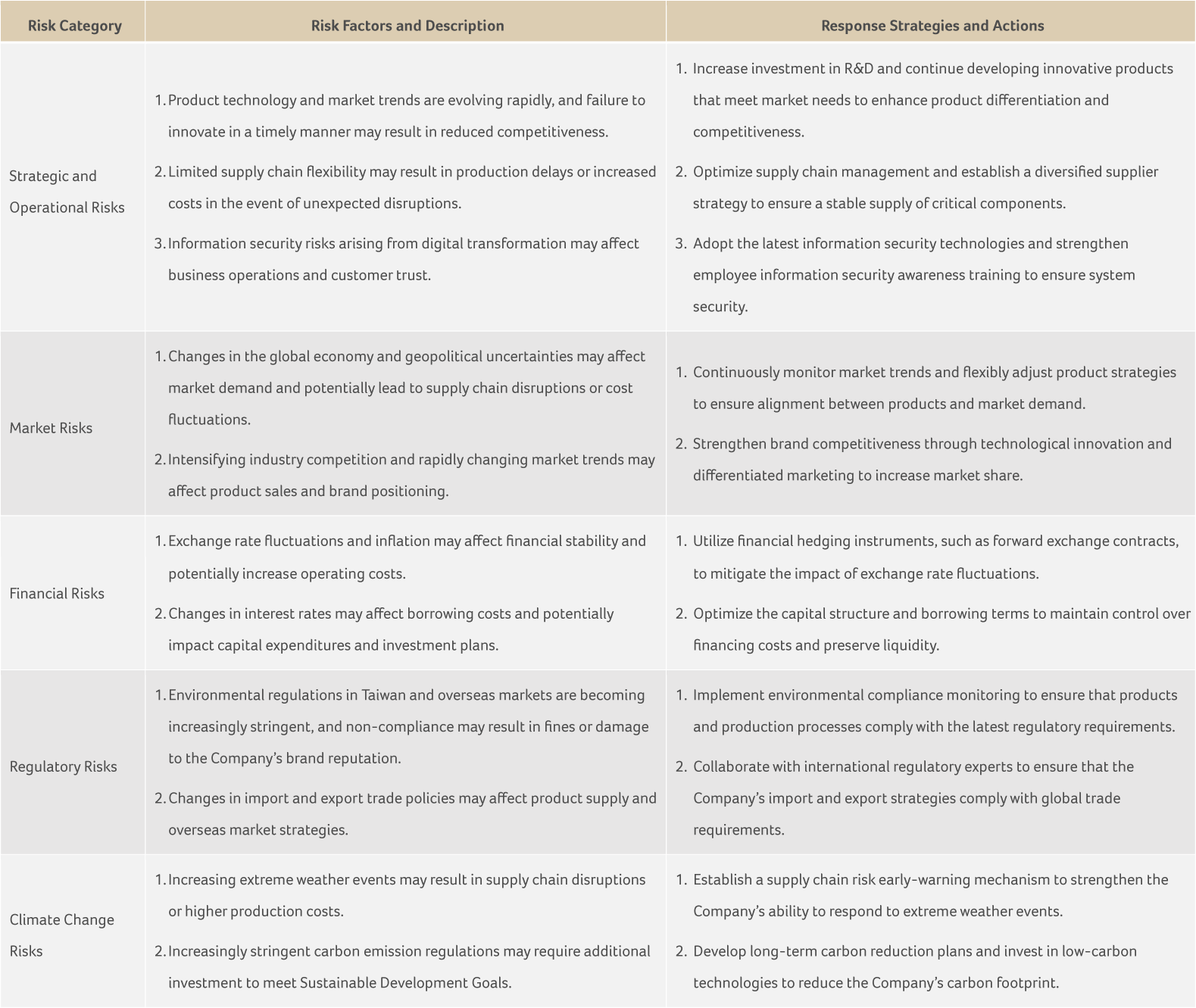
Acer Gadget monitors historical risk events and potential risk factors to ensure the effectiveness of its risk management mechanisms, with management responsible for their implementation and continuous enhancement. The risk management system is also continuously adjusted in response to changes in the operating environment to ensure alignment between risk management and the Company’s strategic direction. In addition, Acer Gadget will continue to fulfill management’s responsibilities for risk management and align its practices with global market standards to strengthen organizational resilience and competitiveness.
Information Security
The Company continuously monitors changes in information security threats, regulations, and the technology environment. Based on operational needs, it reviews relevant management mechanisms and progressively strengthens information security governance, risk management, and operational resilience to support digital operations, stakeholder trust, and the Company’s long-term sustainable development.
In accordance with the Acer Group’s Information Security Policy and internal management requirements, the Company has established information security governance and risk management mechanisms. The Information Security Management Representative coordinates information security-related activities and works with business units, the Personal Data Protection Officer, the Information Security Working Group, and the Emergency Response Team to implement information security management, risk assessments, incident response, and related improvement measures in accordance with their respective responsibilities.
The Company conducts regular information security risk assessments and reviews with the Acer Group’s information security team. Based on operational needs, the importance of information assets, risk assessment results, the technology environment, and applicable regulations, the Company reviews relevant management measures and control mechanisms. Through applicable information security testing and audit mechanisms, the Company also identifies potential risks and areas for improvement, which serve as a basis for subsequent risk response and adjustments to management measures.
The Company has not yet obtained third-party certification under ISO/IEC 27001. At this stage, the Acer Group’s information security policy and the Company’s internal management requirements serve as the foundation for information security management. Relevant management measures will continue to be reviewed based on actual operations, risk assessments, and regulatory requirements.
Information Security Incident Management and Operational Resilience
The Company has established an information security incident management mechanism under which incidents are assessed and handled according to their nature, scope of impact, and level of risk. Cross-departmental collaboration is used to implement necessary response and follow-up measures:
1. Identification and Reporting: When an information security anomaly or incident is identified, it is recorded, initially assessed, and reported in accordance with internal procedures. Depending on the nature of the incident, the relevant responsible functions are engaged for coordinated handling.
2. Assessment and Response: Appropriate control and response measures are implemented based on the type, scope of impact, and risk level of the incident. These measures may include restricting abnormal access, adjusting security settings, and strengthening monitoring to manage potential impacts arising from the incident.
3. Analysis and Improvement: Following incident resolution, the Company conducts root cause analysis and reviews the handling results as appropriate, assesses the need to improve control measures and management processes, and incorporates relevant lessons learned into subsequent risk management activities.
In response to digital operations, cloud applications, supply chain connectivity, and evolving information security threats, the Company continuously reviews its information security management capabilities across people, processes, and technology. These efforts cover information security awareness and professional training, information asset protection, identity and access management, endpoint security, privileged account management, security monitoring, vulnerability management, and applicable information security testing and response exercises.
Through a management cycle encompassing governance and accountability, risk identification and assessment, controls and monitoring, incident response, and improvement tracking, the Company continuously reviews the adequacy of its information security control measures. The Company progressively enhances the consistency, traceability, and operational resilience of its information security management, while adjusting management priorities in response to changes in the digital environment and risk landscape to support business continuity, digital trust, and long-term sustainable development.
Information Security Strategy
Acer Gadget continues to build upon its existing information security management framework. In accordance with the Acer Group’s information security governance principles, the Company’s Information Security Management Representative works with the information technology team to implement relevant management measures. Through risk assessments, information security monitoring, and cross-functional collaboration, the Company continuously reviews information security- and privacy-related risks and management measures in response to operational needs, regulatory requirements, and changes in the external information security environment.
In 2025, the Company continued its existing seven-part information security management framework. Based on actual operational and risk management needs, key management areas—including information security governance, risk management, network and system security, access controls, data and privacy protection, incident response, business continuity, and employee information security awareness—were incorporated into the existing mechanisms for ongoing implementation.
- In accordance with the Group’s information security governance principles and the Company’s management requirements, review information security policies, management processes, and accountability mechanisms.
- Conduct regular information security risk assessments and track relevant management measures based on the assessment results.
- Continuously monitor applicable regulations and management requirements related to information security, personal data, and privacy.
- Manage information security risks related to external connections and unauthorized access through network protection, access controls, and related security mechanisms.
- Review network architecture and related security configurations based on information security risks and operational needs.
- Manage accounts, identity authentication, and access privileges based on business needs and access management principles.
- Regularly review account and access privilege settings and make necessary adjustments in accordance with management procedures.
- Manage security risks related to information equipment, systems, and applications through measures including endpoint protection, system maintenance, and vulnerability management.˙
- Conduct necessary follow-up and remediation based on vulnerability assessments and risk assessment results.
- Conduct information security monitoring and identify, report, respond to, and track information security incidents in accordance with established reporting and incident handling mechanisms.
- Conduct necessary reviews based on the nature and impact of incidents and use the results as a reference for subsequent adjustments to management measures.
- Perform data backup and recovery management based on operational needs and regularly review the relevant mechanisms.
- Review risk assessment and business continuity management measures based on risk assessments and critical business requirements.
- Continue to build employee awareness of information security and privacy protection through information security communications and training.
- Monitor changes in information security threats, regulations, and the technology environment and review relevant management measures based on actual risks and operational needs.
- Incorporate data and privacy protection into the scope of information security management and ongoing review.
To strengthen information security awareness among all employees, Acer Gadget continues to conduct training in accordance with the Acer Group’s information security policy. The results of information security-related training in 2025 were as follows:
- Online Information Security Training: In 2025, a total of 116 participants completed online information security training courses covering information security policies, information security operating procedures, social engineering protection, and common attack techniques.
- Privacy Protection Training: In 2025, a total of 47 participants took part in Acer’s global privacy protection training, covering personal data protection principles, data processing requirements, and risk identification and management.
In addition, Acer Gadget continues to strengthen its information security capabilities through training courses and practical exercises to enhance employees’ information security protection and incident response capabilities and establish a comprehensive information security governance mechanism in response to increasingly severe information security threats.
Acer Gadget follows the Acer Group’s Global Privacy Policy and is committed to protecting the personal data of customers, employees, and business partners, ensuring that all data collection, processing, and storage comply with applicable laws and regulations and internal corporate requirements. To safeguard information privacy, the Company has designated a responsible person for personal data protection to implement relevant privacy protection policies and works closely with the Acer Group’s information security and legal teams to ensure the effective implementation of personal data protection mechanisms.
- Alignment with International Standards: Acer Gadget references ISO 27701 (Privacy Information Management System), the EU General Data Protection Regulation (GDPR), and Taiwan’s Personal Data Protection Act to ensure that its privacy protection practices comply with applicable international and local requirements.
- Privacy Management Mechanisms: The Company has established internal privacy protection requirements and requires all functions involved in processing personal data to comply with internal personal data management principles and other relevant requirements, covering customer data, employee personal data, and supply chain collaboration information.
- Transparent Data Processing: [EC34.1]Acer Gadget ensures that all personal data is collected, used, and stored in a lawful and ethical manner and clearly informs data subjects of their relevant rights and the scope of data use.
Personal Data Management and Control Mechanisms:
- Privacy Risk Assessment: Conduct regular internal privacy risk assessments with the Acer information security team to identify potential risks and enhance protection mechanisms.
- Access Privilege Management: Implement the principle of least privilege to ensure that only authorized personnel can access specific personal data.
- Data De-identification Technologies: Encrypt and de-identify sensitive data to minimize the risk of data leakage.
Incident Response and Customer Data Protection:
- Personal Data Incident Response: In the event of a personal data breach, the Company will promptly notify the Acer Group’s information security and legal teams in accordance with its information security and privacy protection response plans and conduct incident investigations and implement remedial measures.
- Stakeholder Grievance Mechanism: Establish comprehensive personal data management and customer complaint handling mechanisms to ensure that customers and employees can raise privacy concerns through designated grievance channels.
- Regularly review information protection mechanisms and continue to monitor updates and developments in relevant Acer Group policies as a reference for adjusting and enhancing the Company’s internal systems.
- Continue to enhance the maturity of privacy management. Going forward, the Company will introduce more stringent personal data protection review mechanisms to ensure that privacy management evolves in line with business growth.
- Promote the application of digital privacy technologies, strengthen data access controls, and reduce the risk of personal data breaches.
Supplier Management
Annual supplier management and evaluation primarily focus on Tier A and B suppliers, with differentiated management based on suppliers’ contribution to the supply chain, supply risk, and ESG management requirements. Critical suppliers with relatively high supply chain contribution and risk exposure are included within the scope of focused management, with continued attention to their ESG management practices and sustainability-related issues. Other suppliers are subject to routine management and review based on applicable management requirements. For suppliers presenting ESG or other management-related risks, the Company strengthens supply chain sustainability and resilience through communication, engagement, and follow-up on necessary corrective actions.
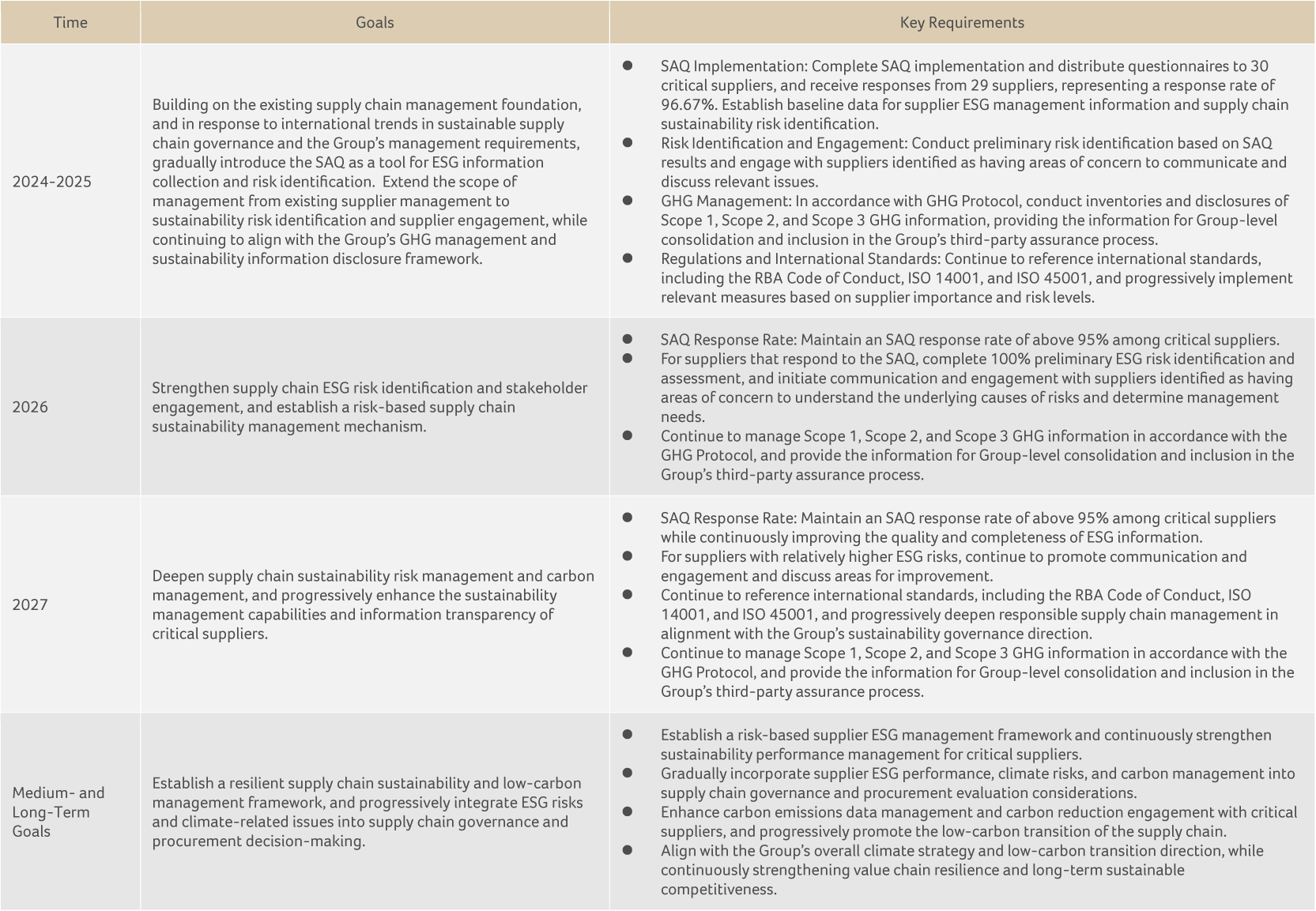
Centered on delivering high-value products and services, Acer Gadget regards its suppliers as key partners in its value chain. Upholding the principles of fair trade, mutual benefit and shared prosperity, and a responsible supply chain, the Company continues to deepen supply chain collaboration and sustainability governance to strengthen the resilience and long-term competitiveness of its value chain. Amid rapid changes in global markets and evolving sustainability trends, the Company continues to create long-term value together with its supply chain partners and to strengthen its environmental, social, and governance (ESG) management to address the opportunities and challenges arising from global sustainable development.
In 2025, the Company maintained its existing supply chain management strategy. In line with the Group’s sustainability governance direction and global trends toward responsible value chains, it continued to enhance supplier ESG information transparency, sustainability risk identification, and supplier engagement. These efforts progressively strengthened the resilience of its supply chain governance and its capacity to manage a responsible value chain, while remaining aligned with the Group’s overall sustainability strategy and international sustainable governance trends.
To strengthen supply chain governance and management effectiveness, Acer Gadget classifies suppliers based on their level of transaction activity:
Class A Supplier: Suppliers with transactions within the past year, including core partners.
Class B Supplier: Suppliers with transactions within the past three years but none within the past year.
Class C Supplier: Suppliers with no transactions within the past three years. Suppliers with no transaction record for more than five years are automatically removed from the Approved Supplier List.
The Company’s core supply chain partners are primarily final product assembly plants, with production sites located in Taiwan (15%) and China (85%).
Number of suppliers in 2025:
Class A Supplier: 112 suppliers
Class B Supplier: 87 suppliers
Class C Supplier: 57 suppliers
The total number of suppliers in 2025 decreased compared with the previous year. This was mainly due to the Company’s ongoing periodic review and adjustment of its supplier list based on transaction activity and supply chain management needs, which has gradually consolidated and focused the supply chain structure. This adjustment improves supply chain management efficiency and information transparency, and allows management resources to be concentrated on partners with active transactions and meaningful supply chain contributions, providing a foundation for deeper ESG risk identification and responsible value chain management.
Supplier Evaluation and Audit
To ensure suppliers meet the Company’s management requirements, Acer Gadget conducts a qualification review prior to the first transaction in accordance with its supplier management mechanism, primarily assessing quality, delivery performance, cost, and terms of trade. Existing suppliers are subject to ongoing review based on their classification and management needs, with ESG management and risk identification being progressively incorporated into the process.
In 2025, the Company further strengthened supplier ESG information management by collecting information from critical suppliers through Self-Assessment Questionnaires (SAQs). This serves as a basis for understanding suppliers’ current ESG management practices and identifying potential sustainability risks. Based on the assessment results, the Company conducts communication, engagement, or follow-up as needed.
Class A Supplier: Reviewed periodically in line with supplier management needs, and included within the scope of ESG information collection and risk identification for critical suppliers.
Class B Supplier: Reviewed periodically in line with supplier management needs, and included in ESG information collection and management based on their supply chain contribution and risk level.
Class C Supplier: Suppliers with no transaction record for five or more consecutive years are removed from the Approved Supplier List in accordance with the Company’s management mechanism. If transactions resume, they must be requalified through the new supplier review process.
Sustainability Management and Compliance
Acer Gadget places continued emphasis on suppliers’ compliance with applicable laws and regulations and international management standards. Based on each supplier’s operational characteristics and management needs, the Company continues to promote the adoption and certification of relevant management systems to strengthen suppliers’ capabilities in quality, environmental, occupational health and safety, and energy management. In 2025, suppliers held the following management system certifications:
ISO 9001 Quality Management Systems: 7 suppliers
ISO 14001 Environmental Management System: 20 suppliers
ISO 45001 Occupational Health and Safety Management System: 14 suppliers
ISO 50001 Energy Management System: 5 suppliers
In the course of supplier selection and management, the Company collects ESG management information through SAQs covering environmental, social, and labor/human rights aspects, including greenhouse gas and climate management, energy and renewable energy use, labor rights, and working conditions. This information serves as the basis for supply chain ESG risk identification and supplier engagement, enabling the Company to deepen responsible supply chain management according to each supplier’s risk level and management needs.
Integrity Management and Risk Management
Acer Gadget values integrity management and responsible governance across its supply chain. When establishing a business relationship and signing a contract, the Company also requires suppliers to sign an Integrity Commitment, pledging to comply with the principles of ethical business conduct and anti-corruption, so that both parties jointly maintain fair, transparent, and responsible business relationships. Through its supplier management mechanism, the Company continues to monitor potential environmental, social, human rights, and integrity risks. Where a supplier is involved in a material environmental, social, or integrity risk event, the Company evaluates the event based on its nature and severity, and takes communication, corrective action follow-up, or other appropriate management measures as necessary. If a supplier commits a material violation of laws and regulations or of the principles of ethical business conduct, or causes significant adverse environmental or social impacts, the Company will address the risk in accordance with its management mechanism and may, where necessary, suspend cooperation or revoke the supplier’s qualification, in order to uphold responsible supply chain governance and the Company’s long-term sustainable development.
In line with the sustainability governance direction of its parent company, the Acer Group, Acer Gadget continues to advance responsible supply chain management and incorporates regulatory compliance, environmental, labor and human rights, and occupational health and safety issues into the scope of supplier management. Suppliers comply with applicable laws, regulations, and related requirements in each location where they operate, and the Company continues to monitor their management practices through its supply chain management mechanism.
The Company also encourages suppliers to address environmental and social responsibility within their own supply chains, gradually extending the reach of responsible supply chain management. Going forward, guided by the Group’s sustainability governance direction and international trends in responsible supply chains, the Company will continue to enhance supply chain information transparency, risk management, and responsible value chain practices.
Supplier Management Process
1. Supplier Code of Conduct and Integrity Commitment
In addition to signing contracts based on commercial terms, suppliers sign documents required under the Company’s management mechanism, including a declaration of conformity with the Responsible Business Alliance (RBA) Code of Conduct, personal data protection clauses, and an Integrity Commitment. These form the basis for cooperation and responsible governance between both parties.
2. ESG Information Collection and Risk Identification
Supplier ESG management information covering environmental, social, and labor/human rights aspects is collected through SAQs. In 2025, the Company continued to expand SAQ coverage, with the number of suppliers surveyed increasing from the previous year. Preliminary risk identification is conducted based on the responses and serves as a reference for subsequent communication, engagement, and management measures.
3. Audits, Engagement, and Corrective Action Follow-up
Based on supplier management needs and risk levels, the Company assesses suppliers’ current management practices through document reviews, audits where necessary, and communication and engagement. For identified issues of concern, the Company communicates with suppliers as appropriate and tracks improvement progress, while encouraging suppliers to continue addressing environmental, social, and labor/human rights issues to progressively deepen responsible supply chain management.
4. Training Planning and Building Management Capabilities
In 2025, the Company evaluated and planned approaches to building suppliers’ sustainability management capabilities. Considering the operational characteristics of its supply chain and related environmental and occupational health and safety risks, the Company prioritized the ISO 14001 Environmental Management System and the ISO 45001 Occupational Health and Safety Management System as focus areas. Both standards are internationally recognized and closely related to supply chain environmental management, pollution prevention, occupational health and safety, and working conditions, making them a suitable reference framework for future supplier training and capacity-building measures. Related training remains at the evaluation and planning stage, and the Company will progressively determine appropriate implementation approaches based on supplier risk levels and management needs.
Based on each supplier’s location, industry characteristics, and product and supply chain relevance, the Company considers the following potential risks:
- Geographic risk: Factors such as the local regulatory environment, labor conditions, resources, and geographic conditions.
- Industry risk: Issues such as industry characteristics, manufacturing processes, occupational health and safety, and working conditions.
- Product and supply chain risk: Issues such as low-carbon manufacturing, energy efficiency, supply chain management, and responsible minerals.
The Company collects supplier ESG management information through SAQs and, based on supplier characteristics and risk levels, focuses on the following management aspects:
- Operations and governance: Operational stability, quality management, ESG disclosure, business integrity, information confidentiality, stakeholder communication, and supply chain management.
- Social and human rights: Human rights, labor practices, occupational health and safety, working hours management, training, and responsible minerals.
- Environmental management: Greenhouse gas management and reduction, energy and renewable energy use, carbon footprint, hazardous substance management, environmental compliance, waste management, and biodiversity.
The Company conducts preliminary risk identification based on SAQ responses and uses this information as a reference for subsequent communication, engagement, and management measures. For issues of concern, the Company conducts communication, engagement, or corrective action follow-up as appropriate, based on supplier characteristics and risk levels, and encourages suppliers to continue addressing ESG issues to progressively deepen responsible value chain management.
In 2025, the Company continued to expand the scope of SAQ information collection and supplier engagement, with the number of suppliers surveyed increasing from the previous year, progressively broadening ESG information coverage across the supply chain.
In 2025, Acer Gadget maintained its existing supplier management principles and further incorporated supply chain contribution, transaction relevance, operational importance, and potential ESG risks into its criticality assessment, which serves as the basis for ESG information collection, risk identification, and engagement management.
- Critical suppliers: Suppliers that are highly relevant to the Company’s operations or to the supply of its products or services, or that pose higher potential ESG risks. These suppliers are prioritized for ESG information collection, risk identification, and communication and engagement where necessary.
- Non-critical suppliers: Suppliers with a comparatively lower impact on operations and the supply chain that have not currently been identified as high ESG risk. These suppliers are managed appropriately based on actual transactions and management needs, and are encouraged to continue addressing ESG issues.
The Company continues to review and adjust these classifications as appropriate, based on supply chain structure, transaction status, and risk levels. The Class A/B/C classification reflects transaction activity, while the critical/non-critical classification reflects management priority and ESG risk considerations. Each serves a distinct management purpose, together supporting risk-based responsible value chain management.
Acer Gadget values labor rights, human rights protection, and occupational health and safety across its responsible value chain. Guided by the sustainability governance direction and responsible supply chain management principles of its parent company, the Acer Group, and with reference to international frameworks such as the Responsible Business Alliance (RBA) Code of Conduct, the Company continues to monitor suppliers’ labor conditions, human rights, and working environments.
In 2025, building on its existing supply chain labor and human rights management approach, the Company further adopted a risk-based management approach. It collected relevant information through SAQs, conducted preliminary risk identification, and pursued communication, engagement, and corrective action follow-up where necessary, based on supplier characteristics and risk levels. On issues such as working hours and occupational health and safety, the Company encourages suppliers to continue prioritizing worker well-being and safe working environments, and to progressively strengthen their management capabilities with reference to international standards such as the ISO 45001 Occupational Health and Safety Management System.
Recognizing occupational health and safety as a material issue for a responsible supply chain, in 2025 the Company designated ISO 45001 as a priority focus area for building suppliers’ sustainability management capabilities. It is evaluating related training and capacity-building programs, which will be rolled out progressively according to supplier risk levels and actual management needs.
Through ongoing information collection, risk identification, and supplier engagement, the Company encourages its supply chain partners to jointly address labor and human rights issues and, with a focus on continuous improvement, progressively deepens the social dimension of responsible value chain management.
Acer Gadget values the environmental impacts of its supply chain. Guided by the sustainability governance direction and responsible supply chain management principles of its parent company, the Acer Group, and in alignment with international climate governance trends, the Company continues to monitor issues such as greenhouse gas management, energy use, resource efficiency, and environmental compliance. In 2025, the Company continued the low-carbon value chain management approach adopted in the previous year, further expanded the scope of supply chain environmental information collection and engagement, and progressively deepened environmental management across its responsible value chain in line with the Group’s greenhouse gas management framework and the GHG Protocol.
The Company manages greenhouse gas emissions in accordance with the GHG Protocol. Scope 1 and Scope 2 emissions are inventoried and disclosed in accordance with applicable regulations and management requirements. For Scope 3, the Company works with the Acer Group to compile value chain emissions data, which is included in the Group’s third-party assurance process.
At the present stage, supply chain management focuses primarily on information collection, encouragement, and engagement; the Company does not yet require all suppliers to conduct greenhouse gas inventories or carbon footprint assessments. Through SAQs and other means, the Company gains an understanding of suppliers’ current environmental management practices and encourages suppliers with the relevant capabilities to follow international standards, progressively establishing a foundation for carbon management and enhancing their environmental management capabilities.
Supply Chain Carbon Inventory Progress
In 2025, building on its previous efforts to communicate with suppliers and encourage carbon management, Acer Gadget further expanded the scope of supply chain environmental information collection and engagement. Prioritizing suppliers with higher transaction activity, the Company used SAQs and other means to understand their current greenhouse gas management practices, and encouraged suppliers to gradually establish carbon management frameworks, advance emissions reduction initiatives, and make voluntary disclosures in line with their own management capabilities.
Whereas progress in 2024 centered mainly on core suppliers’ voluntary greenhouse gas management, in 2025 the Company extended its management perspective to supply chain information collection, value chain emissions management, and Group-level data integration. Working with the Acer Group, the Company is compiling Scope 3 value chain emissions data and, in line with international trends and regulatory developments, encourages suppliers to focus on energy efficiency, renewable energy, and the low-carbon transition. These efforts progressively deepen supply chain carbon management and risk-based engagement, steadily advancing environmental management across the responsible value chain.
In response to global sustainable development, regulatory requirements, and trends in responsible value chain governance, Acer Gadget follows the sustainability governance direction and responsible supply chain management principles of its parent company, the Acer Group. The Company continues to integrate ESG issues into supply chain management, guided by responsible procurement, risk identification, supplier engagement, and continuous improvement.
The management adjustments made in 2025 shifted the focus of supplier management from the previous assessment approach toward SAQ-based ESG information collection and risk-based management. Priority is given to suppliers with higher transaction activity, greater supply chain relevance, or potential ESG risks, with information collection, engagement, and continuous improvement progressively enhancing the precision and transparency of supply chain management.
In accordance with Acer Gadget’s supplier management process, and guided by the sustainability governance direction and responsible supply chain management principles of its parent company, the Acer Group, the Company collects supplier ESG management information through SAQs. The evaluation uses a consistent core ESG framework, with content and information requirements adjusted on an applicability basis according to each supplier’s business model, role in the supply chain, and potential ESG risks.
Evaluation Scope and Key Focus Areas:
- Sustainable Management and Governance: Sustainable management responsibilities, policies and management procedures, legal compliance, integrity management, and management systems
- Labor and Human Rights: Labor rights, human rights protection, working conditions, working hours management, and ethical standards
- Occupational Health and Safety: Health and safety management responsibilities, risk identification, hazard control, and management systems
- Environment, Energy, and Climate Change: Environmental compliance, environmental management, energy use, greenhouse gas management, climate risk, resource efficiency, and pollution prevention
The Company conducts supplier self-assessments using a consistent core ESG framework, adjusting applicable questions based on each supplier’s actual operational characteristics and risk level. SAQ results serve primarily as a reference for supply chain ESG information collection, risk identification, and subsequent communication and engagement. The Company also encourages suppliers to continuously enhance their sustainability management capabilities, progressively deepening responsible value chain management.
In 2025, Acer Gadget continued to use SAQs as a tool for supplier ESG information collection and risk identification, and incorporated supplier ESG assessments into an annual management cycle. SAQs are, in principle, conducted once a year. In line with the Acer Group’s sustainability governance direction, international sustainable development trends, and relevant regulatory requirements, the assessment enables the Company to understand suppliers’ current ESG management practices and potential risks. Risk-based grading then serves as a reference for subsequent communication and engagement, capacity building, and continuous improvement.
Beginning in 2026, the Company plans to conduct the annual SAQ assessment in the first half of each year, covering supplier list confirmation, questionnaire completion, data review, and scoring. Based on their total scores, suppliers are assigned one of three grades:
Grade A (80-100 points) : Qualified
Meets current supply chain ESG management requirements. Suppliers are encouraged to maintain good management practices and to keep abreast of international sustainability trends and regulatory developments.
Grade B (60–80 points) : Conditionally Approved
Cooperation is maintained in principle. The Company engages with suppliers on areas for improvement, encourages them to strengthen relevant management capabilities, and tracks improvement as appropriate.
Grade C (below 60 points) : Improvement Required
Designated as a priority for improvement. The Company helps suppliers strengthen their ESG management capabilities through communication, engagement, and improvement plans. If no improvement is made within a reasonable period, the Company will evaluate the continuation of the business relationship in accordance with its supplier management policy.
The Company adopts appropriate management measures based on suppliers’ transaction activity, supply chain relevance, and potential ESG risks. It encourages suppliers to continuously strengthen their management capabilities in the environment, labor and human rights, occupational health and safety, and integrity and governance, progressively aligning with international frameworks and standards such as the RBA Code of Conduct, ISO 14001, ISO 45001, and the GHG Protocol.
By establishing a management cycle of annual SAQ assessments, risk grading, communication and engagement, corrective action follow-up, and disclosure, Acer Gadget continues to strengthen supply chain transparency and responsible value chain governance. Together with its suppliers, the Company advances sustainability management capabilities and long-term resilience, steadily building a global value chain aligned with international trends, legal compliance, and responsible procurement.
In 2025, Acer Gadget completed SAQ-based ESG assessments of 29 suppliers and graded them according to the results. Of these, 7 suppliers (24.1%) were rated Grade A (Qualified), 11 (37.9%) were rated Grade B (Conditionally Approved), and 11 (37.9%) were rated Grade C (Improvement Required).
Grade A and Grade B suppliers together totaled 18, or 62.1% of the suppliers assessed. This indicates that most assessed suppliers already have a basic level of ESG management in place, or can maintain their business relationship with the Company through continuous improvement. For Grade B and Grade C suppliers, the Company will conduct communication, engagement, and corrective action follow-up based on assessment results and actual risk levels, encouraging suppliers to continuously strengthen their management capabilities in the environment, labor and human rights, occupational health and safety, and integrity and governance.
Guided by the Acer Group’s sustainability governance direction, relevant regulations, and international trends in responsible supply chains, the Company will continue to advance supplier ESG management through a risk-based approach and, through annual SAQ assessments and follow-up engagement, progressively enhance supply chain transparency and management capabilities.
Whereas in 2024 the main improvement focus was to progressively help suppliers implement greenhouse gas inventories and PCF management, in 2025 the Company adjusted its approach based on the SAQ results and the actual maturity of its supply chain, moving to risk-based, phased implementation supported by ongoing communication and engagement. Given differences in supplier size, industry characteristics, and management capabilities, the Company does not, at this stage, require all suppliers to fully implement such systems immediately. Instead, it prioritizes suppliers with higher transaction activity, greater supply chain relevance, or potential ESG risks, and continues to track their current management practices and improvement needs.
In response to global trends in climate change, carbon management, and responsible value chain governance, the Company will continue to follow the Acer Group’s sustainability governance direction, using legal compliance as its foundation and international frameworks as its reference. It encourages suppliers with greater supply chain relevance to progressively strengthen their greenhouse gas and energy management capabilities with reference to international frameworks and standards such as the GHG Protocol and ISO 14001. For PCF management, the Company encourages suppliers to progressively build a data foundation suited to their product characteristics and actual management maturity, and to evaluate further steps such as reduction targets, third-party verification, or carbon labeling as practical conditions allow.
The Company will continue to track supply chain management progress through annual SAQs, risk grading, and follow-up engagement, and will adjust the scope and approach of its management as appropriate based on actual results. Through phased management that progresses from information gathering and risk identification to capacity building, the Company will steadily advance supply chain climate and carbon management, progressively enhancing transparency, climate resilience, and responsible value chain governance, and working with suppliers toward a global value chain aligned with international trends, regulatory compliance, and long-term sustainable development.
Customer Service
To enhance the customer experience, Acer Gadget listens to customer needs through multiple service channels, including a customer service hotline, email, and social media platforms (such as its Facebook fan page), providing timely and professional responses. The Company has established rigorous service procedures to ensure that consumers’ issues are properly resolved, whether they relate to product inquiries, the purchasing experience, after-sales support, or feedback on sales channels and promotional activities.
Acer Gadget has a professional customer service team. All customer service staff receive regular training covering product knowledge, communication skills, patient handling of inquiries, and customer service standards, ensuring that every employee addresses customer questions and needs with sincerity, professionalism, and efficiency. We believe that only by continuously listening to the voice of the customer, improving service quality, and driving innovation and improvement can we keep creating greater value for customers and secure Acer Gadget’s competitiveness and long-term development.
Carrying forward the vision of its parent company, Acer, Acer Gadget is committed to providing efficient, high-quality customer care through innovative technology and attentive service, with the aim of becoming a leading brand built on sustainable operations.
Acer Gadget is committed to providing diverse and efficient customer contact channels, ensuring customers can obtain the support and services they need at any time. Acer Gadget’s customer contact channels include:
- Official website: Customers can visit Acer Gadget’s official website at any time to look up product information, troubleshoot issues, obtain technical support, and purchase the Company’s products.
- Customer Service Center: Acer Gadget operates a professional Customer Service Center that provides comprehensive technical support and consultation services, ensuring customer issues are resolved promptly. Customers can share comments and suggestions by phone or email.
Customer service email: Service@acergadget.com
Acer Gadget has established a customer service and product issue handling mechanism in which customer service representatives work with relevant specialist teams to receive, assess, analyze, resolve, and respond to issues, with follow-up and record-keeping as necessary. Cross-departmental communication and follow-up management are carried out according to the nature of each issue.
When a customer raises a product issue or repair request, a customer service representative receives the case and conducts an initial review. If the case involves a product malfunction or requires further technical analysis, it is escalated to the relevant specialist team for analysis and resolution in accordance with internal procedures. Based on the outcome, the customer is offered appropriate technical support, repair, or other after-sales service options. Case outcomes are confirmed and recorded according to the type of service provided.
Drawing on customer service cases, product issues, and related feedback, the Company continuously monitors service and quality issues, using this information as a reference for reviewing and improving product quality, technical support, customer service, and after-sales service management. In this way, the Company is progressively building a service management mechanism that spans customer feedback, issue resolution, and improvement follow-up.
The Company uses an after-sales service management system and related digital tools to support customer service and after-sales service processes across different markets. These cover information on service cases, repair operations, technical support, service partners, and spare parts management, and are managed by market, product type, and service model.
By integrating service processes and related information, the Company gains visibility into service case handling, product issues, and spare parts demand, which serves as a reference for service resource allocation, spare parts planning, issue tracking, and after-sales service management. The Company also continuously reviews its systems and management processes in light of its product portfolio, market demand, and actual service operations, progressively improving the consistency, traceability, and management efficiency of service information to support the operation and continuous improvement of its global after-sales service network.
Based on product type, sales market, and service needs, Acer Gadget provides product consultation, technical support, repair, product replacement, and other applicable after-sales services through service partners and an authorized service network. The Company reviews the allocation of service resources according to operating conditions in each market to support customer service and product lifecycle management.
As of the end of 2025, the Company provided after-sales services in 9 countries (France, the United Kingdom, the Netherlands, Denmark, Germany, Italy, Spain, Portugal, and Taiwan) through 6 service partners and 36 service locations. The actual services available in each location vary by product type, warranty terms, and local service model.
In 2025, the Company launched an online self-service repair request service. Consumers can submit a repair request form through the “Service & Support” section of Acer Gadget’s official website to request product service, and can use the “Service Location Finder” to obtain related service information. Through both online and in-person service channels, consumers can access after-sales service information and support in the way that best suits their needs.
Customer Support:https://www.acergadget.com/en/customer-support
Service Location Inquiry:https://www.acergadget.com/en/customer-support/inquiry-service
The Company provides product warranty services according to product type and sales market. Actual warranty periods and service terms are subject to each product’s warranty policy and the announcements for each sales region. In Taiwan, certain electric scooter products come with a two-year warranty. For products that require installation, accessory upgrades, or technical support, the Company provides consultation and technical support through the applicable service channels, depending on product type and actual service model.
The Company continuously reviews its after-sales service mechanism in light of its product portfolio, market demand, and service operations. Through its physical service network and digital service channels, it helps customers access product service information and after-sales support, and this also forms the basis for the Company’s ongoing review of customer service and product lifecycle management.
The Company values customer opinions and the service experience. It collects and reviews customer feedback through various service channels and combines this with customer service performance indicators and service case information as a reference for continuous improvement of products, service processes, and customer relationship management.
Depending on market characteristics and actual service models, the Company gathers customer feedback through telephone surveys, online questionnaires, in-person interviews, and interviews with corporate clients. In 2025, these surveys were conducted mainly in Taiwan. Issues and suggestions raised with service centers and partners during the service process are also recorded and reported back in accordance with relevant procedures. The customer service unit regularly reviews service cases and customer feedback to identify key service issues and trends, which serve as a reference for service management and for evaluating improvement measures.
The Company has set service performance indicators for its telephone customer service and digital service channels, and regularly tracks actual performance. Key customer service performance results for 2025 were as follows:
| 2025 Customer Service KPIs | Annual Target | 2025 Performance |
|---|---|---|
| Call answer rate | ≥95% | 95.0% |
| Average Wait Time (AWT) | ≤30 seconds | 13 seconds |
| Average Handle Time (AHT) | ≤7 minutes | 5 minutes |
| Email/chat response rate within 48 hours | 100% | 100% |
The Company regularly reviews customer feedback, service cases, and customer service performance data. Depending on the nature of each issue, the relevant units carry out analysis, follow-up, and improvement as necessary, progressively refining the customer service management mechanism.
Looking ahead to 2026, the Company will progressively expand its methods for gathering customer feedback in line with market and service needs, and will evaluate the use of online questionnaires, digital service tools, and service data analytics to better understand customer feedback and key service issues across different markets. It will also continue to review its online self-service options, service case management, and cross-departmental issue resolution processes to improve the consistency and traceability of service information.
The Company places great importance on protecting customer privacy and personal data during product inquiries, after-sales service, and repairs. In accordance with applicable laws and regulations, internal management rules, and service procedures, it has established mechanisms for the collection, processing, use, and management of personal data, and conducts reviews as necessary based on regulatory requirements and actual service models in each market.
Key management measures in the service process include:
- Notification and Consent
In applicable service and repair processes, customers are informed about the collection, processing, and use of their personal data, and the necessary consent is obtained in accordance with applicable laws and service requirements. - Service Records and Traceability
In line with customer service and repair procedures, necessary records are kept for applicable service calls and cases to support service case management, quality review, and follow-up. These records are managed in accordance with internal management rules and applicable laws. - Data Backup Reminders
For products with data storage functions, customers are reminded, where applicable, to back up important data before sending products for repair, reducing the impact of any data loss that may occur during the repair process. - Risk Notification and Personal Data Rights
Depending on the product and service context, customers are informed of matters such as potential data loss or changes to device settings during repair. Customers’ personal data and related rights are handled in accordance with applicable laws and Company management rules.
The Company continues to review its customer privacy and personal data protection mechanisms in light of regulatory requirements, product and service models, customer service processes, and actual operations, and incorporates the relevant requirements into its service processes and management practices to support the ongoing management of customer service, information security, and privacy protection.